
232653

三氧化铬(VI)
ReagentPlus®, 99.9% trace metals basis
别名:
铬酸酐
登录 查看组织和合同定价。
选择尺寸
变更视图
关于此项目
经验公式(希尔记法):
CrO3
化学文摘社编号:
分子量:
99.99
NACRES:
NA.55
PubChem Substance ID:
UNSPSC Code:
12352303
EC Number:
215-607-8
MDL number:
Assay:
99.9% trace metals basis
Form:
(powder and or flakes)
Quality Segment
product line
ReagentPlus®
assay
99.9% trace metals basis
form
(powder and or flakes)
pH
<1 (20 °C, 100 g/L)
mp
196 °C (dec.) (lit.)
SMILES string
O=[Cr](=O)=O
InChI
1S/Cr.3O
InChI key
WGLPBDUCMAPZCE-UHFFFAOYSA-N
General description
Chromium (VI) oxide is acidic anhydride of chromic acid. It is a useful oxidizing reagent for the conversions of:,Carbon-hydrogen bonds to alcohols,,Alkenes to α, β-unsaturated ketones,Alcohol to aldehydes, acids, and keto acids.
Application
与氯化铵一起用于将氢化苯偶姻氧化成苯偶酰。
Chromium (VI) oxide may be employed as a catalyst for the following reactions:
- Transformation of various primary alcohols to carboxylic acids.
- Oxidation of arenes (naphthalenes and anthrathene) to the corresponding quinones by using periodic acid as the terminal oxidant in acetonitrile.
- Benzylic oxidation of various substituted toluene to the corresponding benzoic acids.
- Oxidation of sulfides to sulfones.
Legal Information
ReagentPlus is a registered trademark of Merck KGaA, Darmstadt, Germany
Still not finding the right product?
Explore all of our products under 三氧化铬(VI)
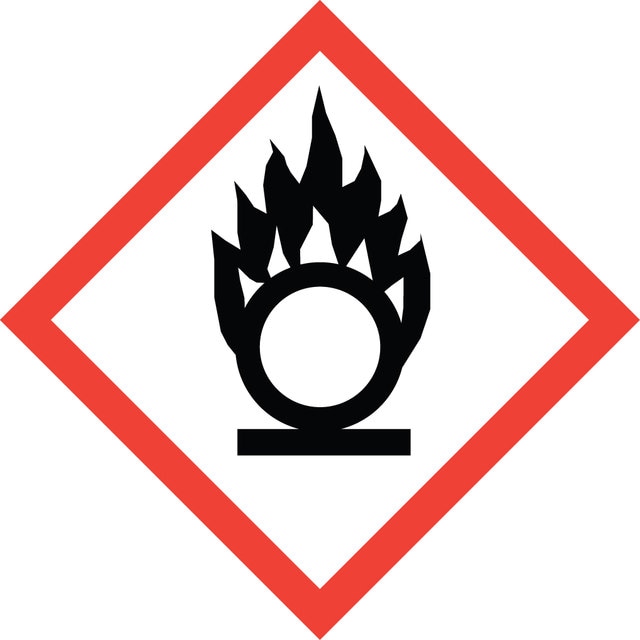




signalword
Danger
Hazard Classifications
Acute Tox. 2 Inhalation - Acute Tox. 3 Dermal - Acute Tox. 3 Oral - Aquatic Acute 1 - Aquatic Chronic 1 - Carc. 1A - Eye Dam. 1 - Muta. 1B - Ox. Sol. 1 - Repr. 2 - Resp. Sens. 1 - Skin Corr. 1A - Skin Sens. 1 - STOT RE 1 Inhalation - STOT SE 3
target_organs
Respiratory system
存储类别
5.1A - Strongly oxidizing hazardous materials
wgk
WGK 3
flash_point_f
Not applicable
flash_point_c
Not applicable
法规信息
危险化学品
此项目有
Letters in Organic Chemistry, 3, 842-842 (2006)
Chromium (VI) Oxide.
Freeman F, et al.
e-EROS Encyclopedia of Reagents for Organic Synthesis. (2008)
Chromium (VI) oxide-catalyzed oxidation of arenes with periodic acid.
Yamazaki S.
Tetrahedron Letters, 42(19), 3355-3357 (2001)
全球贸易项目编号
| 货号 | GTIN |
|---|---|
| 232653-1KG | 04061838783639 |
| 232653-100G | 04061838783622 |
| 232653-2.5KG | 04061838783646 |