跳转至内容
Merck
CN

236470

三氧化铬(VI)

ACS reagent, ≥98.0%

别名:

铬酸酐

登录 查看组织和合同定价。

选择尺寸


关于此项目

经验公式(希尔记法):
CrO3
化学文摘社编号:
分子量:
99.99
NACRES:
NB.24
PubChem Substance ID:
UNSPSC Code:
12352303
EC Number:
215-607-8
MDL number:
Assay:
≥98.0%
Grade:
ACS reagent
Form:
powder or crystals
技术服务
需要帮助?我们经验丰富的科学家团队随时乐意为您服务。
让我们为您提供帮助
技术服务
需要帮助?我们经验丰富的科学家团队随时乐意为您服务。
让我们为您提供帮助

产品名称

三氧化铬(VI), ACS reagent, ≥98.0%

InChI key

WGLPBDUCMAPZCE-UHFFFAOYSA-N

InChI

1S/Cr.3O

SMILES string

O=[Cr](=O)=O

grade

ACS reagent

assay

≥98.0%

form

powder or crystals

reaction suitability

reagent type: oxidant

impurities

≤0.01% insolubles

pH

<1 (20 °C, 100 g/L)

mp

196 °C (dec.) (lit.)

anion traces

chloride (Cl-): ≤0.005%
nitrate (NO3-): ≤0.05%
sulfate (SO42-): ≤0.005%

cation traces

Fe, Al, Ba: ≤0.03%
Na: ≤0.2%

Quality Level

正在寻找类似产品? 访问 产品对比指南

General description

氧化铬(VI)是一种氧化剂,可用于将碳氢键氧化为醇,将烷基芳烃氧化为酮和羧酸,将烯烃氧化为 α, β-不饱和酮,将芳烃氧化为醌,将醇氧化为醛、酮、酸和酮酸

signalword

Danger

Hazard Classifications

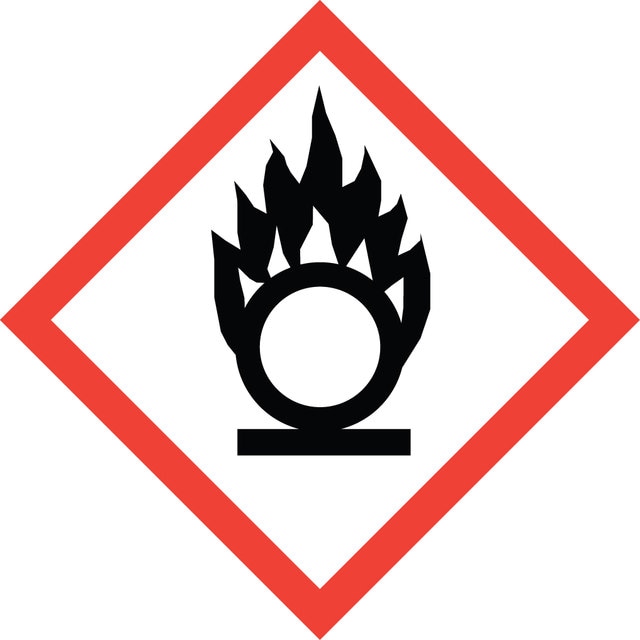
Acute Tox. 2 Inhalation - Acute Tox. 3 Dermal - Acute Tox. 3 Oral - Aquatic Acute 1 - Aquatic Chronic 1 - Carc. 1A - Eye Dam. 1 - Muta. 1B - Ox. Sol. 1 - Repr. 2 - Resp. Sens. 1 - Skin Corr. 1A - Skin Sens. 1 - STOT RE 1 Inhalation - STOT SE 3

target_organs

Respiratory system

存储类别

5.1A - Strongly oxidizing hazardous materials

wgk

WGK 3

flash_point_f

Not applicable

flash_point_c

Not applicable

法规信息

危险化学品
此项目有

历史批次信息供参考:

分析证书(COA)

Lot/Batch Number

没有发现合适的版本?

如果您需要特殊版本,可通过批号或批次号查找具体证书。

已有该产品?

在文件库中查找您最近购买产品的文档。

访问文档库

Chromium (VI) Oxide
Freeman F, et al.
e-EROS Encyclopedia of Reagents for Organic Synthesis (2001)
Chromium (VI) Oxide.
Freeman F, et al.
e-EROS Encyclopedia of Reagents for Organic Synthesis. (2008)
Chromium (VI) oxide-catalyzed oxidation of arenes with periodic acid.
Yamazaki S.
Tetrahedron Letters, 42(19), 3355-3357 (2001)
Sara L Holland et al.
Toxicology in vitro : an international journal published in association with BIBRA, 24(6), 1764-1767 (2010-07-20)
Toxicity of the environmental carcinogen chromate is known to involve sulfur starvation and also error-prone mRNA translation. Here we reconcile those facts using the yeast model. We demonstrate that: (i) cysteine and methionine starvation mimic Cr-induced translation errors, (ii) genetic
Sethsiri S Samaratunga et al.
Environmental science and pollution research international, 15(1), 27-30 (2008-03-01)
Chromium enters into the aquatic environment as a result of effluent discharge from steel works, electroplating, leather tanning industries and chemical industries. As the Cr(VI) is very harmful to living organisms, it should be quickly removed from the environment when

我们的科学家团队拥有各种研究领域经验,包括生命科学、材料科学、化学合成、色谱、分析及许多其他领域.

联系客户支持