Spectrophotometric Determination of Gold in Cyanidic Electroplating Baths with Rhodamine B
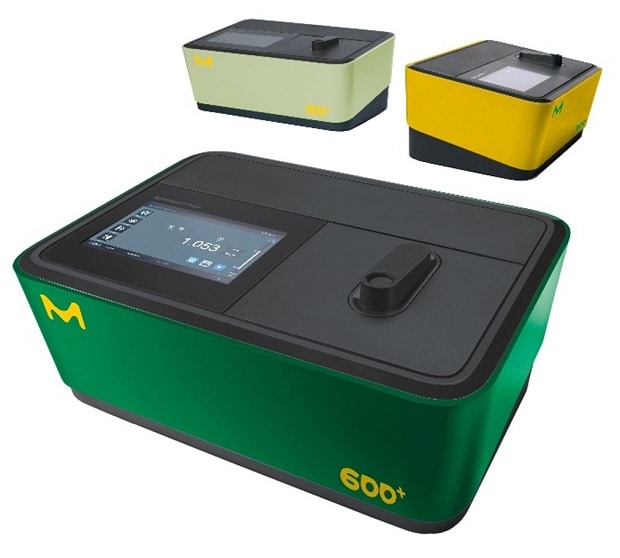
Spectroquant® spectrophotometers - Prove 100 plus, Prove 300 plus, & Prove 600 plus
Introduction
Gold is a noble metal characterized by high electrical and thermal conductivity, excellent corrosion resistance, ductility, and wear resistance, making it a preferred material for various applications in electronics, high-reliability conductors, joining, bonding, and decorative finishes.1 It exists primarily in the +1 and +3 oxidation states; however, Au(III) ions are chemically unstable in aqueous solution due to their tendency to undergo hydrolysis or disproportionation. Consequently, gold electroplating baths are formulated using Au(I) complexes.1
Gold electroplating is an electrochemical process used to deposit a thin layer of gold onto the surface of a conductive substrate. The process, first reported by Luigi Brugnatelli in 1805 using Volta piles, gained industrial relevance in 1840 with the work of Henry and George Elkington, who developed the first cyanide-based gold electroplating bath.2 Today, cyanide- and sulfite-based baths are the most commonly used commercial electrolytes for gold deposition.
Cyanide-based gold electroplating baths are widely favored due to their chemical stability, high deposition efficiency, and long shelf life. The strong complexation of gold with cyanide, forming [Au(CN)₂]⁻, prevents hydrolysis, oxidation, and ligand exchange reactions that otherwise lead to bath decomposition. These baths can operate under alkaline, neutral, or acidic conditions, and exhibit higher deposition rates than non-cyanide alternatives. Additionally, cyanide is cost-effective, and gold cyanide salts are easy to manufacture, contributing to the widespread use of cyanidic systems in gold electroplating.1
Accurate measurement of gold concentration in cyanide electroplating baths is essential to maintain consistent coating quality, optimize metal usage, and ensure process reliability. Conventional analytical techniques such as potentiometry, flame and electrothermal atomic absorption spectrometry, inductively coupled plasma optical emission spectrometry (ICP-OES), and mass spectrometry (ICP-MS) are available for gold determination. While these methods offer high sensitivity and precision, they often require complex instrumentation, extended analysis times, and significant operational costs. This limits their practical use for routine bath monitoring in production environments.3
To address these limitations, colorimetric and spectrophotometric methods using organic reagents have been explored. Reagents such as dithizone, phenothiazine, and sulfonated azo compounds have been investigated, though many result in water-insoluble complexes and require organic solvents. Among these, Rhodamine B offers a suitable alternative for Au(III) detection. In strongly acidic media, Rhodamine B forms a stable, water-soluble purple-colored complex with Au(III), a reaction first described by Ripan et al. (1963).3 This protocol outlines a simple photometric method for the determination of gold in cyanide electroplating baths using the organic dye Rhodamine B, without the need for organic solvents.
Experimental
In cyanidic baths, which contain brighteners at high levels, the gold is bound into a complex, from which must be liberated before determination. For this reason, pretreatment of the sample is necessary. When the cyanidic bath is free of brighteners, sample preparation is unnecessary, since the oxidants in the Spectroquant® Gold test kit will produce the reactive Au(III) form.
Please strictly observe the safety regulations!
Method
The samples are decomposed by digestion to liberate undissolved or complex-bound gold. All gold ions are oxidized to gold(III) ions by an oxidizing agent. In sulfuric solution these react with rhodamine B to form a red-violet complex that is extracted and subsequently determined photometrically.
Measuring Range
0.5 - 12.0 g/L Au
Applicable Sample
Electroplating baths containing cyanides
Reagents, Instruments and Materials
Test/Reagents Kit(s)
- Spectroquant® Gold Test (1.14821)
Instrument(s) & Devices
For the measurement, one of the following Spectroquant® photometers is necessary:
- Spectroquant® VIS Spectrophotometer Prove 100 plus (1.73026)
- Spectroquant® UV/VIS Spectrophotometer Prove 300 plus (1.73027)
- Spectroquant® UV/VIS Spectrophotometer Prove 600 plus (1.73028)
This application note pertains to the above-listed photometers and all discontinued instruments from the Spectroquant® NOVA 60 and Prove series.
Software for Data transfer
- Optional Spectroquant® Prove Connect to LIMS software package (Y.11086) to transfer your data into an existing LIMS system
Instrument Accessories
- Rectangular cells 10 mm (1.14946)
Other Reagents and Accessories
- Hydrochloric acid 37% for analysis (1.00317)
- Nitric acid 65% for analysis (1.00456)
- Hydrogen peroxide 30% (Perhydrol™) for analysis (1.07209)
- Water for analysis (1.16754)
- Heating plate
- Beaker
- 1000-mL volumetric flask
- Pipettes for 1, 2, 5 and 6 mL
Analytical Procedure
Sample Preparation
Safety hint: Sample preparation must be carried out in a fume hood with an adequate air exchange rate, as hydrogen cyanide is produced. Wear safety goggles and protective gloves. Refer to the safety data sheet.
- In a beaker mix 1 mL of sample with 5 mL Perhydrol™ (30%) and 5 mL nitric acid (65%). Attention: hydrogen peroxide evaporates immediately after adding the reagents. Evaporate cautiously to about 2 mL on the heating plate. Add 2 mL hydrochloric acid (37%) and evaporate once more to about 1 mL.
- Treat the residue with 1 mL hydrochloric acid (37%) and 10 mL water for analysis, transfer to a 1000-mL volumetric flask, fill up to the mark with water for analysis, and mix well.
Preparation of Measurement Solutions
Hint: Thoroughly rinse the test tubes and the cells with hydrochloric acid and distilled water prior to each determination
- Pipette 2.0 mL pretreated sample into a test tube with screw cap. (5 - 40 °C)
- Add 2 drops of reagent Au-1 holding the bottle vertically while adding the reagent. Close the tube, and mix.
- Add 4 drops of reagent Au-2 holding the bottle vertically while adding the reagent. Close the tube, and mix.
- Add 6 drops of reagent Au-3, close the tube, and mix. Hold the bottle vertically while adding the reagent!
- Add 6.0 ml of reagent Au-4 with a pipette and close the tube tightly.
- Shake vigorously for 1 min.
- Add 6 drops of reagent Au-5 holding the bottle vertically while adding the reagent, and close the tube.
- Immediately shake vigorously for 1 min
- Withdraw the clear upper (organic) phase with the suction pipette and fill into a 10-mm cell, then measure the sample in the photometer.
Measurement
- It is recommended to zero the method for each new working day. To do this, open the method by inserting the barcode, tap the <Settings> button, and select the <ZERO ADJUSTMENT> menu item. Fill the same cell, which will be used for the sample measurement, with distilled water. After prompting, insert the filled rectangular cell into the cell compartment. The zero adjustment is performed automatically. Confirm the performance of the zero-adjustment procedure by clicking on <OK>.
- After the zero adjustment, fill the measurement sample into the same or a matched rectangular cell and insert the cell into the cell compartment. The measurement starts automatically.
- Read off the result in mg/L from the display.
Notes on the measurement
- For photometric measurement the cells must be clean. Wipe, if necessary, with a clean dry cloth.
- Measurement of turbid solutions yields false-high readings. The extract to be measured (upper layer) must be clear. If this is not the case, leave the test tube to stand for approx. 2 min prior to sucking off the upper layer.
- The color of the measurement solution remains stable for at least 60 min.
Calculation
Gold content in g/L Au = analysis value in mg/L Au
Analytical quality assurance
Analytical quality assurance (AQA) is recommended before each measurement series. To check the photometric measurement system (test reagents, measurement device, handling) and the mode of working, a dilute gold standard solution containing 6.0 mg/l Au can be used. Sample-dependent interferences (matrix effects) can be determined by means of standard addition.
For quality and batch certificates for Spectroquant® test kits, see the website, where you will find all data in production control that are determined in accordance with ISO 8466-1 and DIN 38402 A51.