
IM43

Anti-TIMP-3 Mouse mAb (136-13H4)
liquid, clone 136-13H4, Calbiochem®
别名:
Anti-Tissue Inhibitor of Metalloproteinase-3, Anti-MIG-5
登录 查看组织和合同定价。
选择尺寸
变更视图
关于此项目
UNSPSC Code:
12352203
Clone:
136-13H4, monoclonal
Species reactivity:
human, baboon, rabbit
Application:
—
Citations:
1
biological source
mouse
Quality Level
antibody product type
primary antibodies
clone
136-13H4, monoclonal
form
liquid
contains
≤0.1% sodium azide as preservative
species reactivity
human, baboon, rabbit
should not react with
chicken, porcine, rat, bovine
manufacturer/tradename
Calbiochem®
storage condition
OK to freeze, avoid repeated freeze/thaw cycles
isotype
IgG1
shipped in
wet ice
storage temp.
−20°C
target post-translational modification
unmodified
Gene Information
human ... TIMP3(7078)
General description
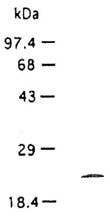
Mouse monoclonal antibody generated by immunizing mice with the specified immunogen and fusing splenocytes with NS1 mouse myeloma cells (see application references). Recognizes both the ~27 kDa glycosylated and the ~24 kDa unglycosylated forms of TIMP-3.
Recognizes the ~27 kDa glycosylated and the ~24 kDa non-glycosylated forms of TIMP-3. Does not cross-react with TIMP-1 or TIMP-2 in CaCO-2 and HEK293 cell and eye tissue.
This Anti-TIMP-3 Mouse mAb (136-13H4) is validated for use in Frozen sections, Immunoblotting, Immunofluorescence, Immunoprecipitation, Paraffin sections for the detection of TIMP-3.
Immunogen
Human
a synthetic peptide corresponding to amino acids 170-188 of human TIMP-3
Application
Frozen sections (2-10 g/ml)
Immunoblotting (5 g/ml)
Immunofluorescence (not recommended)
Immunoprecipitation (not recommended)
Paraffin sections (10 g/ml, heat pre-treatment required, see application references)
Packaging
Please refer to vial label for lot-specific concentration.
Physical form
In 100 mM sodium phosphate buffer, 0.1% BSA, pH 7.0.
Preparation Note
Following initial thaw, aliquot and freeze (-20°C).
Analysis Note
Positive Control
293 or Caco-2 cells or unfixed eye tissue
293 or Caco-2 cells or unfixed eye tissue
Other Notes
Anand-Apte, B., et al. 1997. Invest. Ophthalmol. Vis. Sci.38, 817.
Butler, G.S., et al. 1997. Eur. J. Biochem.244, 653.
Fariss, R.N., et al. 1997. Am. J. Pathol.150, 323.
Vranka, J.A., et al. 1997. Curr. Eye Res.16, 102.
Ruiz, A., et al. 1996. Biochem. Biophys. Res. Commun.226, 467.
Kishnani, N.S., et al. 1995. Matrix Biol.14, 479.
Cottam, D.W. and Rees, R.C. 1993. Intl J. Oncol.2, 861.
Stetler-Stevenson, W. G., et al. 1993. FASEB J.7, 1434.
Woessner, J.F. 1991. FASEB J.5, 2145.
Liotta, L.A. and Stetler-Stevenson, W.G. 1990. in Seminars in Cancer Biology, ed. M. M. Gottesman. Vol. 1(2), 99.
Butler, G.S., et al. 1997. Eur. J. Biochem.244, 653.
Fariss, R.N., et al. 1997. Am. J. Pathol.150, 323.
Vranka, J.A., et al. 1997. Curr. Eye Res.16, 102.
Ruiz, A., et al. 1996. Biochem. Biophys. Res. Commun.226, 467.
Kishnani, N.S., et al. 1995. Matrix Biol.14, 479.
Cottam, D.W. and Rees, R.C. 1993. Intl J. Oncol.2, 861.
Stetler-Stevenson, W. G., et al. 1993. FASEB J.7, 1434.
Woessner, J.F. 1991. FASEB J.5, 2145.
Liotta, L.A. and Stetler-Stevenson, W.G. 1990. in Seminars in Cancer Biology, ed. M. M. Gottesman. Vol. 1(2), 99.
Legal Information
Manufactured by Daiichi Fine Chemical Co., Ltd. Not available for sale in Japan.
CALBIOCHEM is a registered trademark of Merck KGaA, Darmstadt, Germany
Disclaimer
Toxicity: Standard Handling (A)
Still not finding the right product?
试用我们的 产品选型工具 工具缩小选择范围
存储类别
10 - Combustible liquids
wgk
WGK 1
Yasuyuki Shitomi et al.
Molecular biology of the cell, 26(4), 659-673 (2014-12-30)
Discoidin domain receptor 1 (DDR1) is a receptor tyrosine kinase that binds and transmits signals from various collagens in epithelial cells. However, how DDR1-dependent signaling is regulated has not been understood. Here we report that collagen binding induces ADAM10-dependent ectodomain
全球贸易项目编号
| 货号 | GTIN |
|---|---|
| IM43-100UG | 04055977220445 |