
跳转至内容
Merck
CN

12255

重铬酸钾

puriss., ≥99%

别名:

红矾钾

登录 查看组织和合同定价。

选择尺寸

变更视图

关于此项目

线性分子式:
K2Cr2O7
化学文摘社编号:
分子量:
294.18
EC Number:
231-906-6
UNSPSC Code:
12352300
MDL number:
技术服务
需要帮助?我们经验丰富的科学家团队随时乐意为您服务。
让我们为您提供帮助


grade

puriss.

Quality Level

assay

≥99%

reaction suitability

reagent type: oxidant

mp

398 °C (lit.)

anion traces

chloride (Cl-): ≤50 mg/kg, sulfate (SO42-): ≤200 mg/kg

cation traces

Ca: ≤50 mg/kg

SMILES string

[K+].[K+].[O-][Cr](=O)(=O)O[Cr]([O-])(=O)=O

InChI

1S/2Cr.2K.7O/q;;2*+1;;;;;;2*-1

InChI key

KMUONIBRACKNSN-UHFFFAOYSA-N

Other Notes

A -D suffix exists for administrative purposes only.
All -D packages are 100% the same product, same quality, same specification as the package sizes previously sold without a -D.


Still not finding the right product?

Explore all of our products under 重铬酸钾
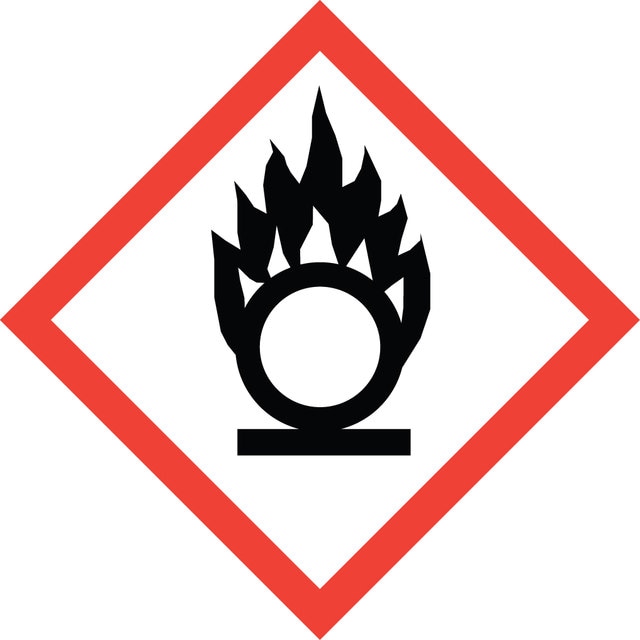

signalword

Danger

Hazard Classifications

Acute Tox. 2 Inhalation - Acute Tox. 3 Oral - Acute Tox. 4 Dermal - Aquatic Acute 1 - Aquatic Chronic 1 - Carc. 1B - Eye Dam. 1 - Muta. 1B - Ox. Sol. 2 - Repr. 1B - Resp. Sens. 1 - Skin Corr. 1B - Skin Sens. 1 - STOT RE 1 Inhalation - STOT SE 3

target_organs

Cardio-vascular system, Respiratory system

存储类别

5.1B - Oxidizing hazardous materials

wgk

WGK 3

flash_point_f

Not applicable

flash_point_c

Not applicable

ppe

dust mask type N95 (US), Eyeshields, Faceshields, Gloves, type P2 (EN 143) respirator cartridges, type P3 (EN 143) respirator cartridges

法规信息

新产品

此项目有


历史批次信息供参考:

分析证书(COA)

Lot/Batch Number

没有发现合适的版本?

如果您需要特殊版本,可通过批号或批次号查找具体证书。

已有该产品?

在文件库中查找您最近购买产品的文档。

访问文档库


Fu-Jun Liu et al.
Toxicological sciences : an official journal of the Society of Toxicology, 110(2), 307-318 (2009-06-03)
Werner syndrome is a premature aging disorder characterized by cancer predisposition that is caused by loss of the Werner syndrome protein (WRN) helicase/exonuclease DNA repair protein. Hexavalent chromium is an environmental carcinogen and genotoxicant that is associated with respiratory cancers
Sean Ekins et al.
Drug metabolism and disposition: the biological fate of chemicals, 38(12), 2302-2308 (2010-09-17)
Drug-induced liver injury (DILI) is one of the most important reasons for drug development failure at both preapproval and postapproval stages. There has been increased interest in developing predictive in vivo, in vitro, and in silico models to identify compounds
Nigel Greene et al.
Chemical research in toxicology, 23(7), 1215-1222 (2010-06-18)
Drug-induced liver injury is a major issue of concern and has led to the withdrawal of a significant number of marketed drugs. An understanding of structure-activity relationships (SARs) of chemicals can make a significant contribution to the identification of potential


全球贸易项目编号

货号GTIN
12255-5ML-F04061838134738



