

grade
ACS reagent
vapor pressure
6.8 mmHg ( 25 °C)
assay
69.0-72.0%, 70%
impurities
≤0.001% N compounds
ign. residue
≤0.003%
color
APHA: ≤10
density
1.664 g/mL at 25 °C
anion traces
SiO32- and PO43-: ≤5 ppm, chloride (Cl-): ≤0.001%, sulfate (SO42-): ≤0.001%
cation traces
Fe: ≤1 ppm
SMILES string
OCl(=O)(=O)=O
InChI
1S/ClHO4/c2-1(3,4)5/h(H,2,3,4,5)
InChI key
VLTRZXGMWDSKGL-UHFFFAOYSA-N
Still not finding the right product?
Explore all of our products under 高氯酸
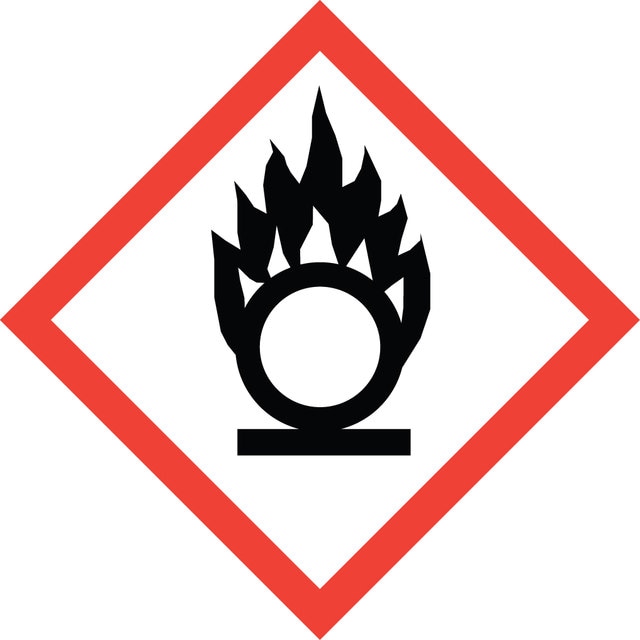



signalword
Danger
Hazard Classifications
Acute Tox. 4 Oral - Eye Dam. 1 - Met. Corr. 1 - Ox. Liq. 1 - Skin Corr. 1A - STOT RE 2
target_organs
Thyroid
存储类别
5.1A - Strongly oxidizing hazardous materials
wgk
WGK 1
flash_point_f
235.4 °F - closed cup
flash_point_c
113 °C - closed cup
ppe
Faceshields, Gloves, Goggles, type ABEK (EN14387) respirator filter
法规信息
新产品
此项目有
John Greenwood et al.
ACS nano, 9(5), 5520-5535 (2015-04-22)
We shine light on the covalent modification of graphite and graphene substrates using diazonium chemistry under ambient conditions. We report on the nature of the chemical modification of these graphitic substrates, the relation between molecular structure and film morphology, and
Dipanwita Das et al.
Journal of the American Chemical Society, 135(10), 4018-4026 (2013-02-28)
Catalytic four-electron reduction of O2 by ferrocene (Fc) and 1,1'-dimethylferrocene (Me2Fc) occurs efficiently with a dinuclear copper(II) complex [Cu(II)2(XYLO)(OH)](2+) (1), where XYLO is a m-xylene-linked bis[(2-(2-pyridyl)ethyl)amine] dinucleating ligand with copper-bridging phenolate moiety], in the presence of perchloric acid (HClO4) in
Dipanwita Das et al.
Journal of the American Chemical Society, 135(7), 2825-2834 (2013-02-12)
Selective two-electron plus two-proton (2e(-)/2H(+)) reduction of O(2) to hydrogen peroxide by ferrocene (Fc) or 1,1'-dimethylferrocene (Me(2)Fc) in the presence of perchloric acid is catalyzed efficiently by a mononuclear copper(II) complex, [Cu(II)(tepa)](2+) (1; tepa = tris[2-(2-pyridyl)ethyl]amine) in acetone. The E(1/2)