
30314

碘酸钾
puriss. p.a., 99.7-100.4%
登录 查看组织和合同定价。
选择尺寸
关于此项目
线性分子式:
KIO3
化学文摘社编号:
分子量:
214.00
UNSPSC Code:
12352302
PubChem Substance ID:
EC Number:
231-831-9
MDL number:
Assay:
99.7-100.4%
Form:
solid
InChI key
JLKDVMWYMMLWTI-UHFFFAOYSA-M
InChI
1S/HIO3.K/c2-1(3)4;/h(H,2,3,4);/q;+1/p-1
SMILES string
[K+].[O-]I(=O)=O
grade
puriss. p.a.
assay
99.7-100.4%
form
solid
impurities
≤0.002% total nitrogen (N)
loss
≤0.05% loss on drying, 130 °C
pH
5.0-8.0 (25 °C, 5%)
mp
560 °C (lit.)
density
3.93 g/mL at 25 °C (lit.)
anion traces
bromide, bromate, chloride, chlorate (as Cl-): ≤100 mg/kg, iodide (I-): ≤10 mg/kg, sulfate (SO42-): ≤50 mg/kg
cation traces
Cu: ≤5 mg/kg, Fe: ≤10 mg/kg, Na: ≤50 mg/kg, Pb: ≤5 mg/kg, Zn: ≤5 mg/kg
正在寻找类似产品? 访问 产品对比指南
General description
Potassium iodate (KIO3) is a colorless solid having monoclinic crystal system. KI solution undergoes anodic oxidation to afford KIO3. KIO3 has strong oxidizing properties. It has been proposed as a promising corrosion inhibitor for carbon steel.
Application
Potassium iodate (KIO3) may be employed in the following studies:
- As primary standard reagent for the volumetric estimations.
- Quantification of hydrolyzable tannins, such as gallotannins and ellagitannins.
- Winkler method for the estimation of dissolved oxygen.
- As a co-inhibitor along with sodium tungstate for prevention of corrosion in carbon steel.
signalword
Danger
存储类别
5.1B - Oxidizing hazardous materials
wgk
WGK 1
flash_point_f
does not flash
flash_point_c
does not flash
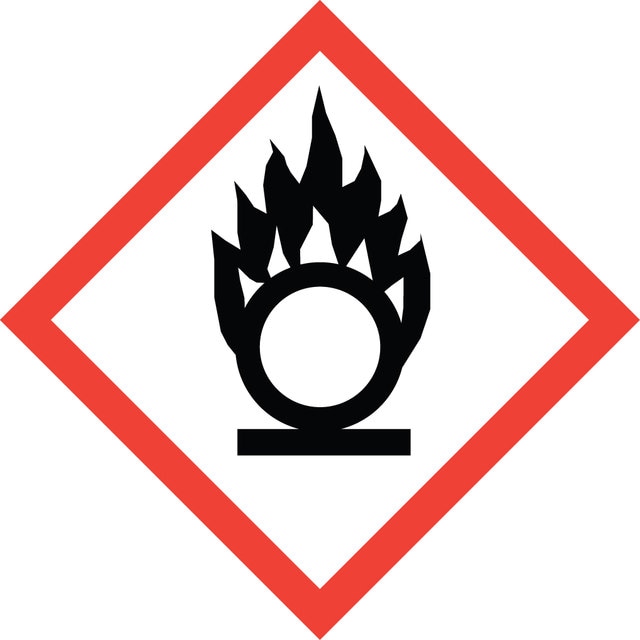


hcodes
Hazard Classifications
Acute Tox. 4 Oral - Eye Irrit. 2 - Ox. Sol. 2 - Repr. 2
法规信息
新产品
此项目有
Eagleson M.
Concise Encyclopedia Chemistry, 889-889 (1994)
Co-inhibition characteristics of sodium tungstate with potassium iodate on mild steel corrosion.
Shibli SMA and Saji VS.
Corrosion Science, 47(9), 2213-2224 (2005)
Paul W Hartzfeld et al.
Journal of agricultural and food chemistry, 50(7), 1785-1790 (2002-03-21)
A widely used method for analyzing hydrolyzable tannins afer reaction with KIO(3) has been modified to include a methanolysis step followed by oxidation with KIO(3). In the new method, hydrolyzable tannins (gallotannins and ellagitannins) are reacted at 85 degrees C
The Chesapeake Bay Institute technique for the Winkler dissolved oxygen method.
Carpenter JH.
Limnology and Oceanography, 10(1), 141-143 (1965)
Ralf Biebinger et al.
The British journal of nutrition, 102(9), 1362-1369 (2009-08-06)
Adverse sensory changes prevent the addition of highly bioavailable ferrous sulfate (FeSO4) to most wheat flours. Poorly absorbable reduced Fe powders are commonly used. Encapsulation of FeSO4 can overcome these sensory changes, but the particle size of commercial compounds is
我们的科学家团队拥有各种研究领域经验,包括生命科学、材料科学、化学合成、色谱、分析及许多其他领域.
联系客户支持