跳转至内容
Merck
CN
HomeSmall Molecule HPLCAscentis Express C18 Column Stationary Phases

Comparison of Ascentis® Express C18 Column Stationary Phases for Analysis of Basic Analytes

Valanka D’Silva
R&D and Customer Support Lab, Jigani, Bangalore, India

Abstract

This study evaluates the performance of various Ascentis® Express C18 column phases for the analysis of basic analytes under two acidic mobile phase conditions, highlighting the superior peak shapes achieved with the PCS-C18 column, which enhances method efficiency and applicability in LC-MS.

Section Overview

Introduction

In this study, we assess the performance of different Ascentis® Express C18 column phases in the analysis of four basic analytes (nebivolol hydrochloride, dextromethorphan hydrobromide, sitagliptin phosphate, and hydroxyamphetamine hydrobromide) using low ionic strength mobile phases. Working with basic compounds is challenging due to their ability to undergo strong secondary interactions with the base silica of C18 columns, thereby producing unsymmetrical peak shapes and compromising the method’s efficiency.

The new Ascentis® Express PCS-C18 column features a positively charged surface (PCS) stationary phase, enabling the retention and elution of basic compounds with significantly improved peak shape under acidic conditions. In this paper, the separation of four basic analytes (Figure 1) was studied on four different Ascentis® Express phases with C18 functionality using weak acidic mobile phase buffers: the well-established Ascentis® Express C18 stationary phase, as well as the more recently introduced columns Ascentis® Express AQ-C18, Ascentis® Express ES-C18, and Ascentis® Express PCS-C18.
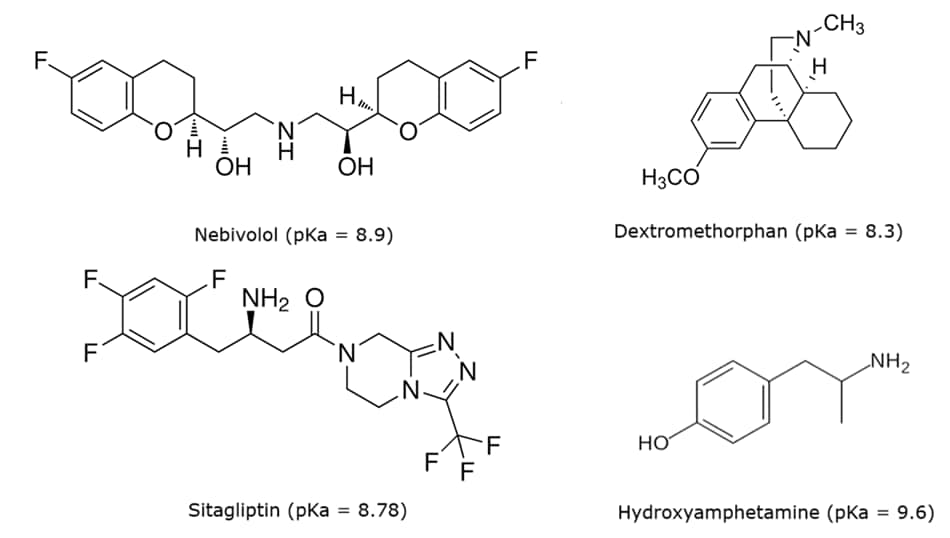
Skeletal chemical structures of four basic compounds, each labeled with its name and corresponding pKa value. In the upper left corner is Nebivolol, a complex molecule with multiple rings, hydroxyl groups, and fluorinated aromatic rings, noted with a pKa of 8.9. To its right is Dextromethorphan, featuring a tricyclic structure with a methoxy group and a methylated amine, labeled with a pKa of 8.3. In the lower left is Sitagliptin, a fluorinated aromatic compound with an amide group, multiple nitrogen atoms in heterocycles, and a trifluoromethyl group, listed with a pKa of 8.78. Finally, in the lower right corner is Hydroxyamphetamine, a simpler structure with a hydroxyl-substituted aromatic ring connected via an ethyl chain to a primary amine, labeled with a pKa of 9.6.

Figure 1.Chemical structures of the basic analytes and their pKa values.1-4

Experimental

Reagent Preparation

The analysis of the basic analytes was separated into two sets using two different acidic mobile phase compositions. Preparation of the mobile phases for the two sets was as follows:

Mobile Phase Set I

  • Mobile phase A: Weigh and dissolve 0.630 g ammonium formate in 1000 mL water. Adjust the pH to 3.0 with formic acid to obtain an aqueous solution of 10 mmol/L ammonium formate, pH 3.0.
  • Mobile phase B: Weigh and dissolve 0.630 g ammonium formate in 200 mL water (50 mmol/L), and mix with 800 mL acetonitrile to obtain a mixture of acetonitrile and 50 mmol/L ammonium formate aqueous solution (80:20, v:v).

Mobile Phase Set II

  • Mobile phase A: Add 1 mL formic acid to 1000 mL water and mix well to obtain a solution of 0.1% formic acid in water.
  • Mobile phase B: Add 1 mL formic acid to 1000 mL acetonitrile and mix well to obtain a solution of 0.1% formic acid in acetonitrile.

Standard Preparation

Standard mix solution: Weigh 20 mg each of nebivolol hydrochloride, dextromethorphan hydrobromide, sitagliptin phosphate, and hydroxyamphetamine hydrobromide into a 50 mL volumetric flask. Add 25 mL methanol and sonicate for 5 minutes. Fill to volume with water and mix well. The resulting solution contains 400 µg/mL of nebivolol hydrochloride, dextromethorphan hydrobromide, sitagliptin phosphate, and hydroxyamphetamine hydrobromide.

HPLC-UV Method

The standard solution was analyzed by HPLC-UV using the two sets of mobile phase compositions (Tables 1 & 2). 

Results

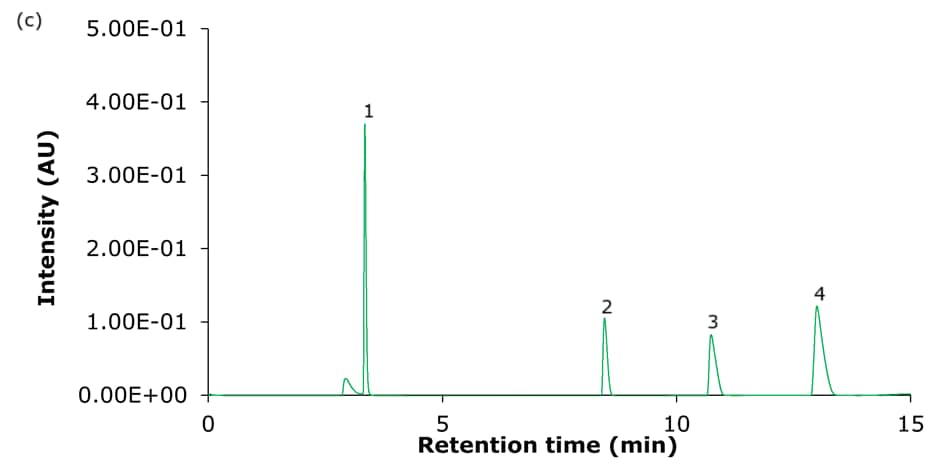
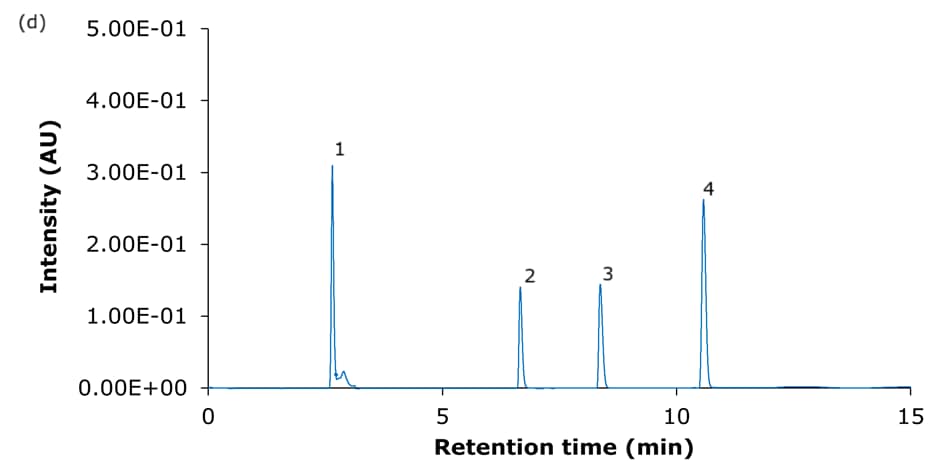
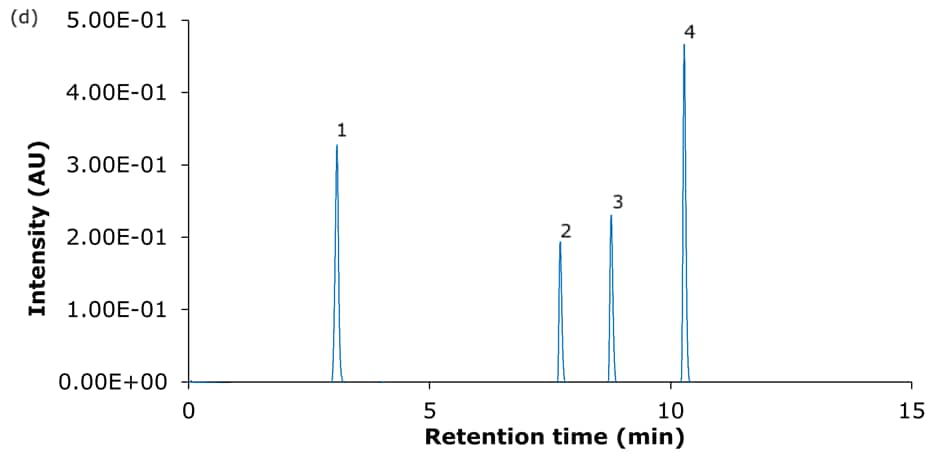
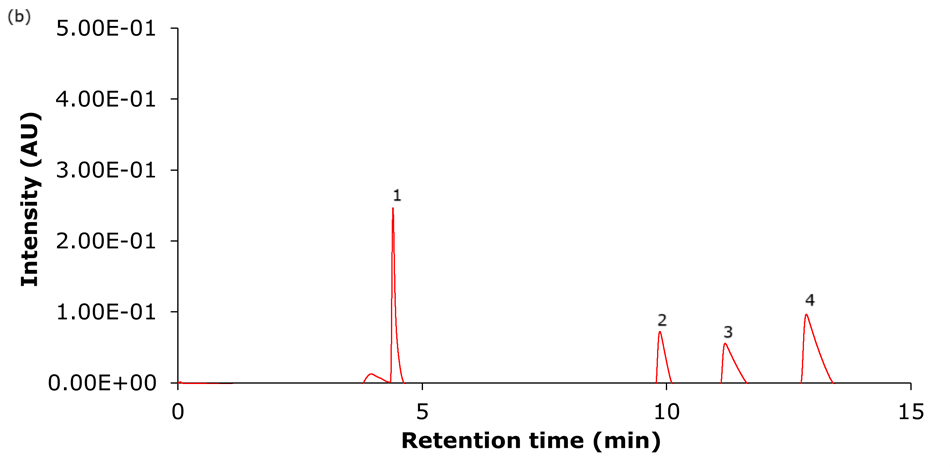
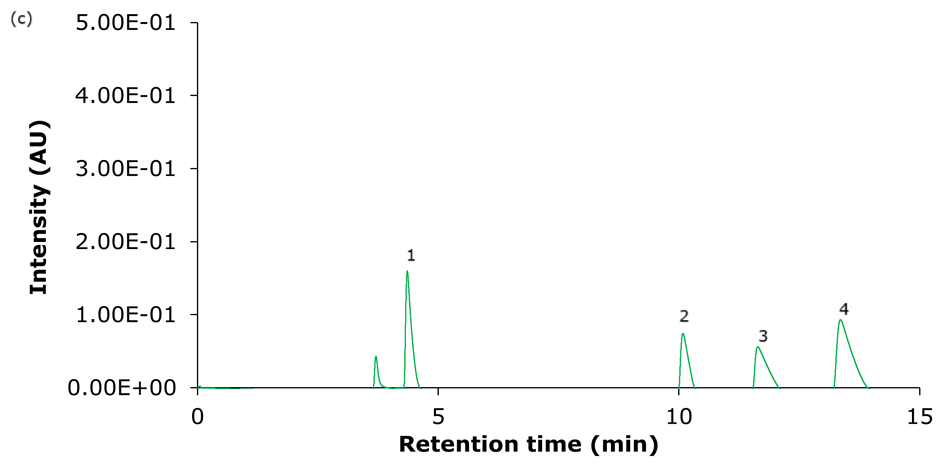
The performance of the four Ascentis® Express C18 columns for the analysis of basic analytes using set I acidic mobile phase composition is demonstrated in Figure 2, and using set II acidic mobile phase composition is demonstrated in Figure 4. Tables 3 & 4 summarize the obtained chromatographic results, including the determined USP symmetry factors (also known as asymmetry or tailing factor, TUSP). Figures 3 & 5 provide a visual comparison of the achieved tailing factors for sets I & II demonstrating the PCS-C18 to provide the most symmetrical peaks and meet the common acceptance window of 0.8-1.8 (USP chapter <621>) for all compounds under the chosen conditions. This is particularly evident for the mobile phase set II (0.1% formic acid). 
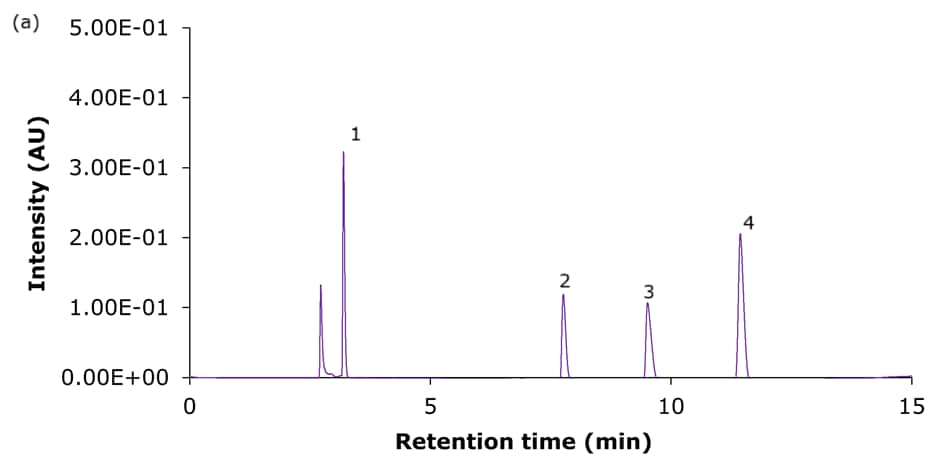
A chromatogram with a white background and a thin purple trace representing the chromatographic signal. The x-axis is labeled “Retention time (min)” and spans from 0 to 15 minutes, while the y-axis is labeled “Intensity (AU)” and ranges from 0.00E+00 to 5.00E-01. Four distinct peaks are visible on the plot. Peak 1 appears sharply at just 3.20 minutes and is the tallest, indicating the highest intensity. Peaks 2 and 3 occur at 7.76 and 9.51 min respectively, both relatively smaller in height. Peak 4 appears at just over 11.44 minutes and has a higher intensity than peaks 2 and 3 but is smaller than peak 1. Each peak is labeled with a number from 1 to 4, corresponding to the compounds analyzed. All peaks show very slight tailing.
A chromatogram with a white background and a thin red trace representing the chromatographic signal. The x-axis is labeled “Retention time (min)” and spans from 0 to 15 minutes, while the y-axis is labeled “Intensity (AU)” and ranges from 0.00E+00 to 5.00E-01. Four distinct peaks are visible on the plot. Peak 1 appears sharply at just 3.40 minutes and is the tallest, indicating the highest intensity. Peaks 2 and 3 occur at 7.89 and 9.79 min respectively, both relatively smaller in height. Peak 4 appears at just over 11.76 minutes and has a higher intensity than peaks 2 and 3 but is smaller than peak 1. Each peak is labeled with a number from 1 to 4, corresponding to the compounds analyzed. All peaks show a slight tailing.
A chromatogram with a white background and a thin green trace representing the chromatographic signal. The x-axis is labeled “Retention time (min)” and spans from 0 to 15 minutes, while the y-axis is labeled “Intensity (AU)” and ranges from 0.00E+00 to 5.00E-01. Four distinct peaks are visible on the plot. Peak 1 appears sharply at just 3.45 minutes and is the tallest, indicating the highest intensity. Peaks 2 and 3 occur at 8.46 and 10.74 min respectively, both relatively smaller in height. Peak 4 appears at just over 13.00 minutes and has a higher intensity than peaks 2 and 3 but is smaller than peak 1. Each peak is labeled with a number from 1 to 4, corresponding to the compounds analyzed. All peaks show a tailing.
A chromatogram with a white background and a thin blue trace representing the chromatographic signal. The x-axis is labeled “Retention time (min)” and spans from 0 to 15 minutes, while the y-axis is labeled “Intensity (AU)” and ranges from 0.00E+00 to 5.00E-01. Four distinct peaks are visible on the plot. Peak 1 appears sharply at just 2.65 minutes and is the tallest, indicating the highest intensity. Peaks 2 and 3 occur at 6.66 and 8.37 min respectively, both relatively smaller in height. Peak 4 appears at just over 10.58 minutes and has a higher intensity than peaks 2 and 3 but is smaller than peak 1. Each peak is labeled with a number from 1 to 4, corresponding to the compounds analyzed. All peaks display a highly symmetric shape.

Figure 2. Representative chromatograms of the analysis of the four basic analytes (1) hydroxyamphetamine, (2) sitagliptin, (3) dextromethorphan, and (4) nebivolol on Ascentis® Express 90 Å phases with C18 functionality - (a) C18, (b) AQ-C18, (c) ES-C18, and (d) PCS-C18 - 15 cm x 4.6 mm, 2.7 μm columns using acidic mobile phase set I. [Table 1, 10 mmol/L ammonium formate in water, pH 3.0/acetonitrile:50 mmol/L ammonium formate in water (80:20 v:v)] 
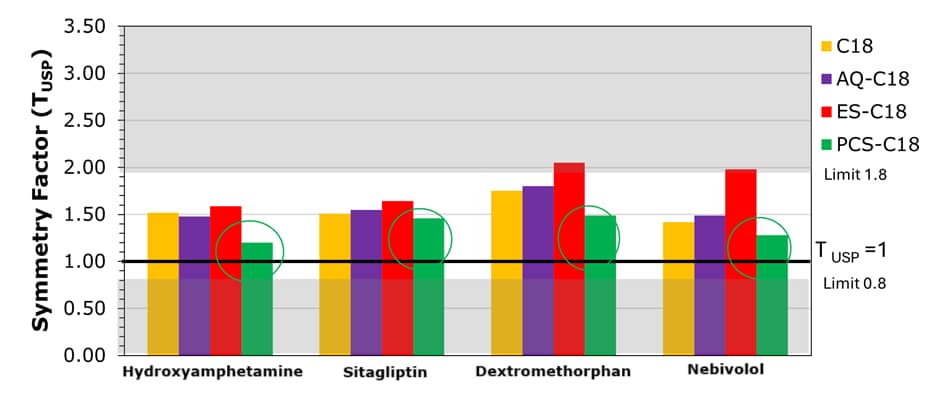
A bar chart on a light gray background that compares the symmetry factor values (TUSP) of four compounds—Hydroxyamphetamine, Sitagliptin, Dextromethorphan, and Nebivolol—using four different chromatographic stationary phases. The y-axis represents the symmetry factor ranging from 0.00 to 3.50, with labeled horizontal reference lines at 0.8, 1.0, and 1.8. A horizontal green line at T_USP = 1 indicates the ideal symmetry factor, while the range limits of 0.8 and 1.8 are noted to indicate acceptable symmetry as per USP Chapter <621>. Each compound has a cluster of four vertical bars: yellow for C18, purple for AQ-C18, red for ES-C18, and cyan blue for PCS-C18. Among these, the PCS-C18 (blue bars) consistently shows values closest to 1 and within the defined limits, while ES-C18 (red bars) often shows higher symmetry factors. Green circles highlight the PCS-C18 bars for each compound to emphasize their performance.

Figure 3.Tailing factors for mobile phase set I demonstrate that the PCS-C18 provides symmetry factors (TUSP) for all compounds within the range limits of 0.8-1.8 (USP chapter <621>), with values closest to the ideal TUSP = 1.
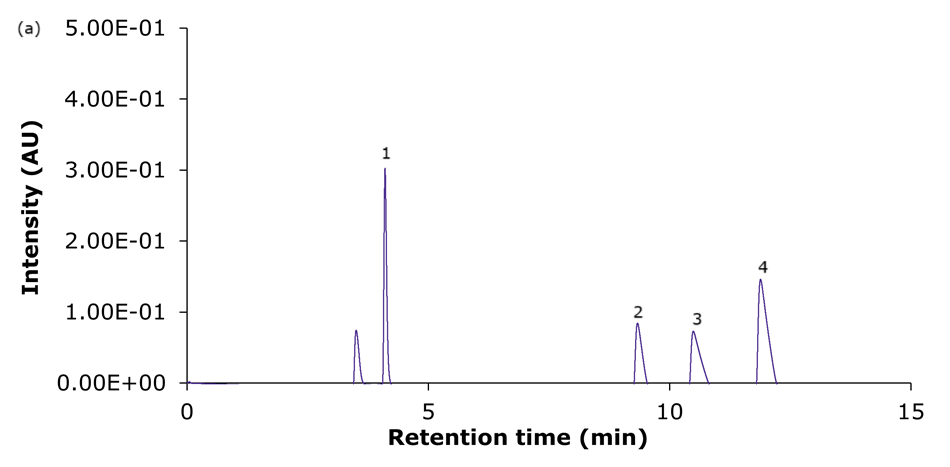
A chromatogram with a white background and a thin purple trace representing the chromatographic signal. The x-axis is labeled “Retention time (min)” and spans from 0 to 15 minutes, while the y-axis is labeled “Intensity (AU)” and ranges from 0.00E+00 to 5.00E-01. Four distinct peaks are visible on the plot. Peak 1 appears sharply at just 4.10 minutes and is the tallest, indicating the highest intensity. Peaks 2 and 3 occur at 9.34 and 10.49 respectively, both relatively smaller in height. Peak 4 appears at just over 11.88 minutes and has a higher intensity than peaks 2 and 3 but is smaller than peak 1. Each peak is labeled with a number from 1 to 4, corresponding to the compounds analyzed. All peaks inparticular 2 to 4 show a tailing.
A chromatogram with a white background and a thin red trace representing the chromatographic signal. The x-axis is labeled “Retention time (min)” and spans from 0 to 15 minutes, while the y-axis is labeled “Intensity (AU)” and ranges from 0.00E+00 to 5.00E-01. Four distinct peaks are visible on the plot. Peak 1 appears sharply at just 4.40 minutes and is the tallest, indicating the highest intensity. Peaks 2 and 3 occur at 9.86 and 11.20 min respectively, both relatively smaller in height. Peak 4 appears at just over 12.86 minutes and has a higher intensity than peaks 2 and 3 but is smaller than peak 1. Each peak is labeled with a number from 1 to 4, corresponding to the compounds analyzed. All peaks show a tailing in particular 2 to 4.
A chromatogram with a white background and a thin green trace representing the chromatographic signal. The x-axis is labeled “Retention time (min)” and spans from 0 to 15 minutes, while the y-axis is labeled “Intensity (AU)” and ranges from 0.00E+00 to 5.00E-01. Four distinct peaks are visible on the plot. Peak 1 appears sharply at just 2.65 minutes and is the tallest, indicating the highest intensity. Peaks 2 and 3 occur at 6.66 and 8.37 respectively, both relatively smaller in height. Peak 4 appears at just over 10.58 minutes and has a higher intensity than peaks 2 and 3 but is smaller than peak 1. Each peak is labeled with a number from 1 to 4, corresponding to the compounds analyzed. All peaks show a clear tailing.
A chromatogram with a white background and a thin blue trace representing the chromatographic signal. The x-axis is labeled “Retention time (min)” and spans from 0 to 15 minutes, while the y-axis is labeled “Intensity (AU)” and ranges from 0.00E+00 to 5.00E-01. Four distinct peaks are visible on the plot. Peak 1 appears sharply at just 4.36 minutes and is the tallest, indicating the highest intensity. Peaks 2 and 3 occur close together at 10.08 and 11.64 respectively, both relatively smaller in height. Peak 4 appears at just over 13.36 minutes and has a higher intensity than peaks 2 and 3 but is smaller than peak 1. Each peak is labeled with a number from 1 to 4, corresponding to the compounds analyzed. All peaks show a very symmetric shape.

Figure 4. Representative chromatograms of the analysis of the four basic analytes (1) hydroxyamphetamine, (2) sitagliptin, (3) dextromethorphan, and (4) nebivolol on Ascentis® Express 90 Å phases with C18 functionality - (a) C18, (b) AQ-C18, (c) ES-C18, and (d) PCS-C18 - 15 cm x 4.6 mm, 2.7 μm columns using acidic mobile phase set II (Table 2: 0.1% formic acid in water/0.1% formic acid in acetonitrile).

A bar chart displaying symmetry factor values (TUSP) for four chemical compounds—Hydroxyamphetamine, Sitagliptin, Dextromethorphan, and Nebivolol—analyzed using four different chromatographic stationary phases. The vertical axis represents the symmetry factor ranging from 0.00 to 3.50, with reference lines marked at values 0.8, 1.0, and 1.8. A bold horizontal green line at 1.0 marks the ideal symmetry factor, while gray bands in the background help differentiate the data ranges. Each compound has a set of four colored vertical bars: yellow for C18, purple for AQ-C18, red for ES-C18, and blue for PCS-C18. The PCS-C18 bars consistently fall within the acceptable range of 0.8 to 1.8 and are closest to the ideal value of 1, as highlighted by green circles drawn around each blue bar. In contrast, bars representing AQ-C18 and ES-C18 show higher values above the ideal range for several compounds.

Figure 5.Tailing factors for mobile phase set II indicate that the PCS-C18 provides symmetry factors (TUSP) for all compounds within the range limits of 0.8-1.8 (USP chapter <621>), with values closest to the ideal TUSP = 1.
Conclusion

In comparison to the other Ascentis® Express phases with C18 functionality, the Ascentis® Express 90 Å PCS-C18 provided better peak shapes for the investigated basic analytes when used with low ionic strength mobile phases, which would also benefit LC-MS applications. The significant role and influence of silanol activity on the chromatographic behavior of basic analytes was underlined by the comparative results of the PCS-C18 to the other C18 phases:

  • The dramatic improvements in tailing factors with the PCS-C18, in particular when using 0.1% formic acid as a mobile phase modifier, and
  • The reduced retention of the analytes on the PCS-C18 phase.

The narrower optimized peak shape results in increased efficiency and peak capacity, allowing for the development of faster and more reliable applications.

This makes the Ascentis® Express 90 Å PCS-C18 column an ideal option for separating basic analytes under acidic conditions and analyzing complex basic mixtures.


Related Products

Discover our selection of the Ascentis® Express 90 Å PCS-C18 (2.7 µm) columns.

Loading

HPLC Columns, Reagents, Solvents , & Reference Materials

Loading

References

1.
Radwan A, salim m, Elkhoudary M, Hadad G, Belal F. 2022. Analytical approaches for the determination of Nebivolol. Records of Pharmaceutical and Biomedical Sciences. 6(1):113-119. https://doi.org/10.21608/rpbs.2022.164715.1174
2.
Abu Reid IO, Gad Kariem EA. 2017. Development and validation of a HPLC method for the simultaneous determination of pseudoephedrine, dextromethorphan, and triprolidine in their combined cough and cold syrups. JAC. 13(11):6011-6017. https://doi.org/10.24297/jac.v13i11.5911
3.
Gurrala S, Panikumar D, Subrahmanyam C. 2023. Chromatographic study of sitagliptin and ertugliflozin under quality-by-design paradigm. Braz. J. Pharm. Sci. 59e21328. https://www.scielo.br/j/bjps/a/6JnrQ9pTVD9bXx9TJTDzK7z/?format=html&lang=en
4.
Yajnesh P, Mubeen G, Ritu Vivek K, Lalitha N, Krishnasis C. 2017. Development and validation of RP-HPLC method for simultaneous estimation of hydroxyamphetamine hydrobromide and tropicamide in ophthalmic formulation. European Journal of Biomedical. 4(1):373-377. https://www.ejbps.com/ejbps/abstract_id/2099
5.
'peak widths' in IUPAC Compendium of Chemical Terminology, 5th ed. International Union of Pure and Applied Chemistry; 2025. Online version 5.0.0, 2025. https://doi.org/10.1351/goldbook.p04466
登录以继续。

如要继续阅读,请登录或创建帐户。

暂无帐户?